Monday 8th February 2016 – London Trip – Tate Modern
Empty Lot (Tate Modern Turbine Hall) by Abraham Cruzvilegas
At first it appeared to be a huge geometric structure with many elements. After reading more about it, I discovered that there were 240 triangular planters filled with soil from 36 sites across London, all different in their texture and colour though this was difficult to see from my second-floor viewing spot. I wanted to walk on it. Ripe for Seed Bombing, I imagined how it would be if plants were growing in the planters and the array of colour that could possibly appear in the summer time. Interesting that through the use of light that the piece will remain unpredictable changing throughout the six month period.

The Telegraph says “This living city of weeds is one of the most exciting works to take over the Turbine Hall” http://www.telegraph.co.uk/art/what-to-see/tate-modern-turbine-hall-abraham-cruzvillegas/
Material Worlds
Material Worlds is very much about using found materials, things discarded or thrown away, no longer needed by our throw-away modern society. The phrase “make do and mend” almost ceases to exist in our modern world. However society’s loss in this case is the modern artist’s gain in a plethora of material that can be utilised into today’s artwork.
Increasingly over the last hundred years, artists have not felt confined by the media traditionally associated with fine art, from watercolours and oil painting, to bronze, stone or wood sculpture. Embracing a proliferation of sometimes unexpected possibilities, they have explored industrial materials and techniques, adapted craft skills, and put the throwaway products of consumer society to new uses.
Tate Modern
Mario Merz & El Anatsui
Thin sheets of aluminium stapled together and flattened bottle tops form the materials used in these statement pieces. Mario Merz makes you look up to see the floating sculpture, giving you a different perspective in that of looking upwards.
Marisa Merz’s Untitled (Living Sculpture) 1966 was made by stapling thin sheets of aluminium into makeshift tubes that she suspended from the ceiling of her kitchen. As if disrupting some functional equipment, such as the ducting for extractors, the work also redefines the place and impact of sculpture: improvised rather than fixed, floating rather than solid, hanging rather than standing. This free approach to everyday materials was key to Merz and the other Italian artists associated with arte povera (‘poor art’) in the late 1960s.
http://www.tate.org.uk/whats-on/tate-modern/display/marisa-merz-and-el-anatsui
El Anatsui makes you look closer to see the detail of this shimmering fabric to discover that the fluid material is actually made of flattened bottle tops.
El Anatsui’s Ink Splash II 2012 takes the use of industrially produced material in a different direction. Metal bottle tops are flattened and stitched together with copper wire, transforming the disposable objects into a shimmering metal cloth. The familiar is shown to be precious and adaptable to a form of composition usually associated with abstract painting.

Artists rooms Phyllida Barlow
http://www.tate.org.uk/whats-on/tate-modern/display/artist-rooms-phyllida-barlow
Phyllida Barlow describes her fascination with the physical experience of handling materials, a fascination which has lasted decades, since the 1960’s in fact.
Phyllida Barlow describes her fascination with the physical experience of handling materials, a fascination which has lasted decades, since the 1960’s in fact.
Upturned house is an abstracted form of something so familiar to all of us, a house, or home. The structure looks like it may collapse, going against the convention of balance, gravity and symmetry.
It reminded me of the phrase “Turning the house upside down”, often used when hunting for lost items. I found the structure chaotic but enchanting, almost like a dolls house that had been broken apart and randomly thrown in a pile – quite the opposite to the careful planning and placement that must have gone into each part of the structure.

Do I agree with the Telegraph’s opinion that this is “patronising Nonsense dressed up as gender equality”? http://www.telegraph.co.uk/women/life/the-tate-modern-womens-room-is-patronising-nonsense-dressed-up-a/
I would like to believe female artists Have space in these landmark galleries because of the quality of their artwork and its relevance in today’s world.
![[no title] 1985-90 by Guerrilla Girls null](https://shesafineartist.blog/wp-content/uploads/2016/03/p78793_10.jpg?w=1100)
Expanded Painting
I particularly liked the piece Spreadout Ron Kitaj (1984-6) by Frank Bowling – an Acrylic and mixed media on canvas, the colours used and the brush strokes and texture of the piece.
In the decades following the Second World War, artists explored a number of radical approaches to the conventions and materials of painting. In Italy in the late 1950s, Pinot Gallizio produced Industrial Paintings on vast rolls of canvas, questioning the idea of the painting as a unique and commercially tradeable object. By bringing together different styles of abstract and figurative painting his work appeared to undermine the authority of either approach.
http://www.tate.org.uk/whats-on/tate-modern/display/expanded-painting

Gustav Metzger
The piece Liquid Crystal Enviroment (1965) created with five modified slide projectors and liquid crystal, a projection piece lasting 22 minutes is an interesting and hypnotic piece.
Gustav Metzger uses unstable materials and chemical reactions to create artworks that embody processes of change, destruction and renewal – Tate Modern
http://www.tate.org.uk/whats-on/tate-modern/display/gustav-metzger

There is also A Gustav Metzger exhibition at Tate Britain.
Artists rooms – Joseph Beuys
German artist Joseph Beuys saw creativity as central to all aspects of human existence. As well as sculpture and performance, his work as an artist came to encompass social theory and political action.
http://www.tate.org.uk/whats-on/tate-modern/display/artist-rooms-joseph-beuys-london
I think the piece , For the lecture: The social organism – a work of art, Bochum, from. 2nd March 1974 1974 (White and brown chalk on blackboard) gives a little bit of insight into the mind of Joseph Beuys, you can almost feel his passion emanating from the chalk board.

“In 1982, Beuys took part in an exhibition in Berlin, where he installed a huge mound of clay and surrounded it with sculptures as well as furniture and tools from his studio. Afterwards he made casts of some of the elements to create Lightning with Stag in its Glare 1958-85. The bolt of lightning itself was a bronze cast from a section of the clay mound, while the stag was cast in aluminium as if illuminated by a sudden flash of light. Made towards the end of Beuys’s life, this major installation addresses themes of finality and death, but also ideas of regeneration and the transformative power of nature” Tate Modern
Beuys appeared to be dealing with the issue of death in the latter part of his life. This piece had a different energy to it, almost like acceptance of the inevitability of life – death.

Lorna Simpson
At first glance Five Day Forecast says Groundhog Day – five similar images of the same girl, her head and legs missing showing discord with her identity – perhaps the lack of identity felt by millions of workers who feel like a small part in the large working organisations of today. The ‘Mis-‘ words describing that level of discord with one’s identity.
http://www.tate.org.uk/art/artworks/simpson-five-day-forecast-t13335
 Permanent Collection

I had little time to view the Permanent Collection at Tate Modern. Tate Modern holds the national collection of British Art from 1500 to the present day, including over 70,000 pieces of work by more than 3000 artists including sketch books, articles and . The Turner Collection is also located at the Tate Modern with over 2500 pieces by William Turner and has the most comprehensive online catalogue of work by William Turner.
http://www.tate.org.uk/about/our-work/collection
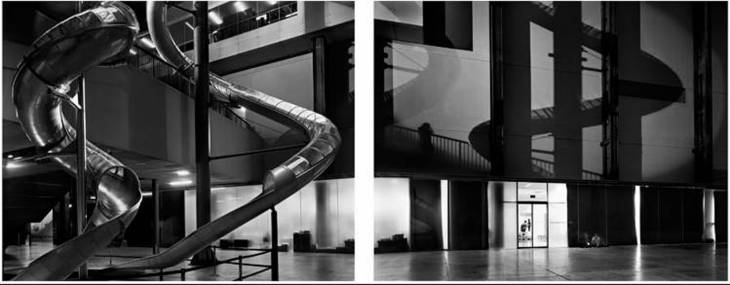
Below is an example of contemporary art held in the Permanent Collection, Slides in the Turbine Hall by Matthew Pillsbury from 2007.

 Michelle Wright, Fine Artist